

.svg)
The first big wins in Lean are often the most visible. Standard work reduces chaos. 5S creates order. Bottlenecks loosen. KPIs move quickly.
Then something happens. Performance plateaus.
The dashboards still look good, but month over month the gains shrink. Kaizen events feel incremental. Teams work hard, yet that next 5% of productivity feels elusive.
Top-performing plants face this challenge too. The difference is how they respond.
Rather than pushing harder on the same levers, leading operations change how they look for improvement — uncovering losses that traditional methods struggle to see. This is how they do it.
Why the “Next 5%” Is Harder Than the First 20%
Early-stage Lean improvements focus on known problems — obvious downtime, clear quality defects, poor material flow, and inconsistent work methods. These issues are relatively easy to identify through observations, audits, and KPIs.
But as maturity increases, losses become:
- Smaller, more frequent, and more variable
- Embedded in normal work rather than exceptional events
- Distributed across shifts, operators, and micro-processes
Examples include small hesitations that repeat hundreds of times per shift, minor adjustments operators make without realizing it, workarounds that no longer trigger alarms, or inefficiencies that have become accepted because output targets are still met. Individually, these losses seem insignificant. Collectively, they quietly consume capacity.
The challenge isn’t effort — it’s visibility.
How High-Performing Plants Change the Game
Top plants don’t abandon Lean principles at this stage. They augment them.
They focus on three shifts in how improvement work is done:
- Moving from sampled observations to continuous insight
- Validating changes with objective evidence
- Scaling learning faster across lines and sites
Let’s look at each.
1. From Snapshot Observations to Continuous Visibility
Traditional time studies and Gemba walks are invaluable — but they are still snapshots.
Even the best observers:
- See a fraction of total production time
- Are influenced by what happens while they’re present
- Must rely on notes, estimates, and memory
Leading plants supplement human observation with continuous video-based process visibility.
Not to watch people — but to understand work.
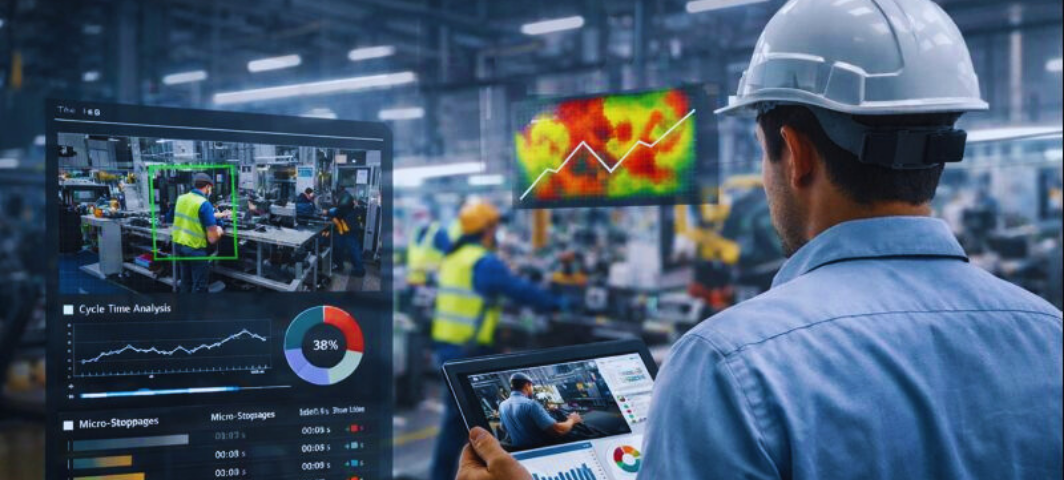
With modern video analytics, teams gain continuous visibility into how work actually flows across entire shifts. They can identify micro-stoppages that never appear in downtime codes, compare best-cycle executions to average ones, and quantify variability between operators or shifts. The result is a much richer picture of where time is really being lost.
Often, the biggest insights come from things teams assumed were already optimized.
2. Turning “I Think It Helped” Into Measured Proof
At higher levels of maturity, improvement ideas tend to be smaller:
- A layout tweak
- A reach reduction
- A change in handoff timing
- A minor tooling adjustment
These changes are notoriously hard to validate.
KPIs don’t always move enough to be convincing. And when volume or mix changes, cause and effect gets blurry.
Top plants address this by validating improvements at the process level, not just the outcome level.
Using before-and-after video analytics, teams can directly measure cycle time changes, confirm reductions in motion or waiting, and verify improvements in consistency — not just averages. Instead of debating whether an idea helped, teams know quickly whether a change worked and by how much.
3. Finding Hidden Losses in “Good” Performance
One of the biggest mindset shifts in elite plants is this: Meeting targets doesn’t mean the process is optimized.
When output is strong, inefficiencies hide behind success.
Video analytics help surface the gap between best-known and most-common work patterns, drift from standard work that still produces acceptable output, fatigue-related slowdowns late in shifts, and accumulated seconds between stations that never trigger alarms. Instead of asking, “Where are we failing?” top teams ask, “Where are we leaving time on the table?” That question is where the next 5% lives.
4. Accelerating Learning Across Teams and Sites
In many organizations, improvement knowledge stays local:
- One line figures something out
- Another plant repeats the same discovery months later
High-performing operations use visual evidence to scale learning.
Because improvements are captured and quantified, teams can:
- Share concrete examples of best execution
- Train faster using real production footage
- Align CI discussions around facts, not opinions
- Replicate gains across lines with confidence
This turns isolated improvements into systemic capability.
The Role of Next-Gen Video Analytics
This new approach is only possible because video analytics have evolved.
Modern solutions are:
- Purpose-built for industrial environments
- Privacy-conscious and people-respectful
- Focused on process signals, not surveillance
- Designed for CI, Ops, and Engineering teams — not data scientists
Technology isn’t the goal. The goal is seeing what was previously invisible — and giving experienced teams better information to act on.
What the Best Plants Have in Common
When you look across high-performing operations chasing their next gains, a pattern emerges.
They:
- Assume there is always more opportunity
- Invest in better visibility, not just more effort
- Validate improvements with data, not anecdotes
- Use technology to amplify Lean thinking, not replace it
The next 5% doesn’t come from working harder. It comes from seeing better.
Ready to see what’s invisible in your operations?
Invisible AI helps leading manufacturers uncover hidden losses, validate improvements, and unlock productivity gains using purpose-built video analytics.
Explore how Invisible AI works and see how top plants are finding their next 5%.


